Boston Marathon: Could it Happen?

Oct 25, 2011 by

Boston Marathon: Could it Happen?
I used to play golf.  A lot of golf.  Like running, I took up golf too late to be a great golfer (darn short game!), and, like my running, I took it a little too serious for many years.  I spent a lot of time (and money) on it and worked my way down to a low handicap.

Now golf and running are not very similar.  But something happened recently that reminded me of my golf days.  See, the problem with golf was that one great shot or one good round that kept you coming back.  You could be cussing and breaking clubs (so, I’ve heard) because of an awful round, ready to quit for good.  Then on the 18th hole, you could hit your longest drive of the day right down the middle, birdie the hole and forget about the other 17 lousy holes.  You’d be ready to go back and play again the next week.

The running equivalent of this phenomena happened to me at the Ray Tanner Home Run 12K.

First, a bit of background. The running equivalent of golf’s U.S. Open, is the Boston Marathon.  In the U.S. Open, if you are a good enough golfer, you can go through the qualifying process to get in.  The Boston Marathon has a qualifying process as well.  It is very simple.  Beat a certain time in a Boston Marathon qualifier-designated marathon and you can enter Boston.  The qualifying times are age-based.  For example, males in the 40-44 year old age group must beat 3 hours 15 minutes to qualify.  Younger runners must be faster and older runners get more time.  Click here to see the entire chart.

So, back to the Home Run.  My goal when I signed up was to beat an 8:00/mile pace.  As the race approached, my training was going well, so I adjusted my goal to 7:45/mile.  On race day, the weather was perfect, and I felt great.  I started out a little faster than goal, but I suspected that would happen.  I intended to dial it back a bit, but as the race progressed, I saw no sign of my body hitting the wall, so I kept up the pace and I finished with a 7:31 pace!  I was shocked when I looked at my watch.  I still felt good, too.  The only other times I had beaten that pace were a couple of 5K’s, and I felt pretty bad at the end.

Back to Boston Qualifying.  The pace one must run a marathon to qualify in the 45-49 age group is a 7:49/mile (3 hours 25 minutes).  Now a 12K (7.44 miles) is a long way from 26.2 miles, but for the first time in my running, I had the feeling that might Boston might be attainable with a couple more years of hard work.   I had smacked a drive right down the middle on the 18th hole, and I was ready to work hard for the next race.

So, is the Boston Marathon in my future?  I don’t know, but it was nice to see progress that gave me a small bit of hope.

POFIFOTO!


read more

Ray Tanner Home Run 12K Race Review

Oct 17, 2011 by

Ray Tanner Home Run 12K Race Review

This was the 6th running of the Ray Tanner Home Run and my first time in the event.  I sure hope I can make it each year.  It was easy to see why this event sold out.  This race should be the model for all races. Here’s a run down of my experience:

Race swag: Technical T-shirt.  By Under Armour.  Very nice.  I’m not 100% sure, but I think the 12K runners shirts were garnet and the 5K’ers were black.  If so, I like that.

Course: I really liked the course.  Fairly fast, but a few good hills to make you work.  Good scenery around downtown Columbia and the avenues of West Columbia, including 2 trips over the Congaree River.  Great finish at home plate inside the South Carolina baseball stadium, easily one of the top collegiate baseball stadiums in the country.  The only slightly negative thing I could say about the course was how we integrated with the 5K runners and walkers.  The 12K started about 20-25 minutes before the 5K and then we starting mixing with them close to mile 3, I believe.  This just made for some difficult maneuvering in the crowd.  No big deal, just part of it.

Post race spread: Awesome.  I snacked on a snow cone and trail mix, but there was also fruit, cookies, cake and hot dogs.  I deemed 9am too early for a hot dog, though.

Weather: Chamber of Commerce morning in Columbia.  I’m not sure how the race director arranged it.  Not a cloud in the sky and the race start temperature was 55-60 degrees with low humidity.

My Performance

As I mentioned in a previous post, the goal I had in this race was to measure my fitness as I train for the Governor’s Cup Half Marathon in 3 weeks.  I had a race pace goal of just under 8:00/mile.  I also hoped to run a negative split, meaning running the second half of the race faster than I did the first.  Let’s see how I did.

I could bore you at this point with a description of each mile, and I what was happening in my head, but I won’t.  Here’s the summary:

Time: 55:49, a 7:31/mile pace.  10th place out of 41 in my age group.  55 of 248 in the male overall category.

Splits

Mile 1: 7:30

Mile 2: 7:48

Mile 3: 7:20

Mile 4: 7:51

Mile 5: 7:51

Mile 6: 7:19

Mile 7: 7:35

Last .44 miles: 2:40ish

So, I accomplished my first goal of a less than 8:00 pace.  I didn’t think I had a 7:31 in me for 12K, but the perfect weather really helped me on this.  This was one of the best races I have ever run.  I never hit a wall or felt ill, as I do the last mile of 5K’s. Also, I believe I did the elusive negative split.  If not, it was very close.  I am very confident right now in my fitness heading into the Governor’s Cup.

Bottom Line: Hope to see you at the Home Run next year!  If you can only do one race in the Columbia area, this should be on your short list.

read more

Epic Failures

Oct 13, 2011 by

Like many endeavors, running is a trial and error activity.  You can read tips and advice all day long, but until you actually try them, you just don’t know if they work for you.  Along the way, I’ve had many failures, usually with painful consequences.  I should have known better in some cases, but I ignored advice (or common sense) and went my own way, resulting in various school of hard knocks “learning experiences”.  In some cases, I repeated the mistake and experienced the same result (sometimes again and again….).  Pavlov might have had trouble using me for his research.

To use today’s teenage vernacular, here are my top epic failures:

1. iRecycle Half Marathon 2009: Deciding on a pace at the race.  My first half marathon ever was the 2009 iRecylcle Half in Spartanburg, SC.  It was 2 months before my first marathon, and I figured it was a good test of my fitness at that point in marathon training.  My goal was to break 2 hours, which is a reasonable 9:00/mile pace.  With less than a year of running, I didn’t understand training very well and was not really following much of a plan.  Just run a bit more each week and have a long weekend run was about the extent of my plan.   A few weeks before this race, I had run a 10K at a sub 8:00/mile pace, so I figured why not try 8:00 pace for the half?  This race had pacers, so I joined the 8:00 pace group on a whim.  I did fine the first 4 miles, but the high humidity and pace got to me.  I finished under 2 hours, but the 2nd half of the race was painful.

Lesson learned: Don’t attempt a pace you haven’t trained for.

2. Kiawah Island Marathon 2009: Attempt at blister prevention. In the weeks leading up to my first marathon at Kiawah Island, I had begun to develop hot spots and blisters on my left foot during long runs in the ball of my foot near the big toe.  A few days before the run, I read about moleskin and decided to try it as a way to prevent a blister.  I applied the moleskin the morning of the marathon and set off.  About mile 2,  the moleskin started bothering me.  About mile 6, I had to stop and remove the moleskin, but the damage was done.  I had caused a blister in a different spot and had to run the final twenty miles with the aggravation of a painful blister.

Lesson learned: If at all possible, don’t try something new or unpracticed on race day.  I also switched to much thinner socks after this, which eliminated my blister problems.

3. Kiawah Island Marathon 2009: Bad bathroom break timing. In three years of running, I have only had to stop for a nature break once – at mile 15 or so of the Kiawah Island Marathon.  I had arrived at the race start well ahead of time and was able to use the facilities about an hour before race start.  Being a rookie marathoner and concerned about hydration, I had probably been drinking too much water.  When I went outside for the start of the race, I needed to use the restroom again, but the lines for the porta johns were now too long.  I decided to wait until the course.  On the first half of the race, the toilets all seemed to be occupied as I passed.  Finally, on the second half, with the half marathoners gone, there was a good spot to stop.  Unfortunately, my full bladder took way too long to empty and my legs must have thought we were done.  So, when I set out to resume the race, my legs were not cooperating. It was a long last 1o+ miles.

Lesson learned: Time the pre-race bathroom trip a little better.

4. 2011 Lexington Race Against Hunger: Running a 10K one week after a marathon. I have a soft spot for a local 10K, the Lexington Race Against Hunger.  This was my first race ever in 2009, is a good cause, and they have great race long sleeve t-shirts.  The race is at the end of February, and this year I ran the Myrtle Beach Marathon the week before.  So, instead of resting after a hard marathon effort, I ran.  After all, it is against my rules to wear the race t-shirt if I didn’t actually run the race!  Everything was going OK, and I was running better than expected, so I saw that I would easily beat my goal of sub 50 minutes.  Then at mile 5, it happened.  I recognized the guy passing me on the left.  Oh, no, Jeff.  Not today.  I picked up the pace.  He did, too.  Over the last mile, we pushed each other and had a great finish.  Unfortunately, my left foot, already stressed from plantar fasciitis in the fall and marathon training all winter, gave up on me.  I came up lame.  Barely able to walk, I limped off with severe pain in the top of my foot.  A few weeks later, x-rays showed stress two stress fractures in my left foot that had healed.  I believe the final push in the 10K caused the fractures.

Lesson learned: Nothing.  I’d probably do it again, just not the all out final race at the end.

You’ll probably have to learn some of the hard lessons on your own, but I hope you can learn from my mistakes.  Sometimes, I do; sometimes, I don’t.

POFIFOTO!

read more

Race Prep

Oct 4, 2011 by

Race Prep

Fall is finally here in the South. The weather is perfect for running and the local race calendar reflects this.  There are literally dozens of events to choose from over the next few months, primarily 5K’s.  As you might be able to tell from my blog, I don’t race much, though.  I mean I don’t run in organized runs too much.  My speed is not exactly called racing!  I’d like to run these “official” races more often, but there are  many  reasons why I don’t race anymore than I do:

1. Cost. With  multiple race choices each weekend, one could easily spend over $100 per month on entry fees.

2. Time. Soccer games, cross country meets.  Attending the kid’s functions usually takes precedence over my run schedule.

3. Injuries. Racing increases my likelihood of injury.  I have hurt my foot a few times during races.  Maybe I push too hard on race day.  Also, being injured has kept me from entering some runs.

4. Longer range planning. Sometimes an organized run doesn’t fit well with my self-imposed training schedule.  If I have a half marathon or full marathon scheduled, and I need to run do 15 mile  run on a Saturday morning, then, to me, it doesn’t make sense to run a 5K that causes me to miss that.  Sometimes a shorter race is smart, though.  More on that in a minute.

Fall/Winter Schedule

Having said all that, I am currently registered for two races and have two more to which I’ve mentally committed but  not shelled out the entry fees.  My first race of the fall is the Ray Tanner Home Run 12K on October 15th.  I have wanted to run this one for a couple of years now, but there has always been a soccer conflict.  No conflict this year, so I’m in.  The second race officially on the schedule is the Governor’s Cup Half Marathon on November 5th.

The other two races are the Harbison 50K Trail Run in January and the Columbia Marathon in March.

Race Prep

Even if my speed and race results show that I have a long way to go to vie for an age-group medal, I still take race preparation seriously.  Here are a couple of things I do before my bigger races:

1. Scout the course.  If the course is local, I can usually work out a time to run it.  If the course is away, requiring an overnight stay, I’ll drive it the day before on the way in.   Maybe it doesn’t help much, but I like to know when the hills are coming.

2. Run a “scrimmage” race 2-3 weeks out. High school football teams play 1/2 game scrimmages before the season starts.  I try to do the same thing with a shorter race a few weeks before a big race.   That is the purpose of the 12K run – to see how my training is coming along for the half marathon.  My goal for the Governor’s Cup is to beat 1:45, which is an 8:00/mile pace.  In the Ray Tanner Home Run, I’ll shoot to beat the 8:00/mile pace by a few seconds.  If I can do it, I’ll know I’m on track.  If not, I may need to adjust my Governor’s Cup goal.

Hope you’ve found time to sign up for a race this fall. If not, there is still time!

POFIFOTO!


read more

Related Posts

Tags

Share This

Product Review: Swiftwick Aspire Socks

Sep 27, 2011 by

Product Review: Swiftwick Aspire Socks

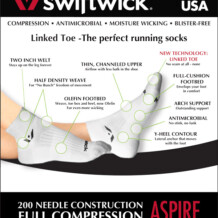
Image Courtesy of Swiftwick.com

A couple of weeks ago, I noticed a new (at least to me) brand of socks in the local Fleet Feet running store – Swiftwick.  I had a gift certificate with some funds left on it, so I figured I’d try them out.  The pair I purchased was a white Aspire One, the ‘One’ meaning the length of the sock.

Short review version: A+

Longer version: These are excellent socks.  I purchased a medium, which is listed as men’s shoe size 6-9.5.  I wear a 9.5 or 10 in most shoes and these fit perfectly.  No unwanted length.

Swiftwick advertises these socks as compression, blister free, and moisture wicking.  They are as advertised.  The materials listed on the package are 53% Nylon, 39% Olefin, and 8% Spandex.

I like the compression feature around the arch, but I honestly don’t know if it does much.  Feels good, though.  I can testify that the blister free and moisture wicking claims are accurate.  I have had run numerous times in them, including speed work,  with no hint of hot spots. Thus, no blisters.   In a major test,  I did a 15 miler in them last weekend in 80 degree 100% humidity weather, and they were awesome.  Every piece of my clothing was saturated in sweat, including my shoes, and my feet stayed comfortable.

I paid $12.99 for my pair, and they are worth it.  I will definitely be purchasing more of Swiftwick’s products in the future.  Also, they are made in the USA.

POFIFOTO!


read more